|
The University
Location
Academic Highlights and Specific Research Opportunities
The University
Ludwig-Maximilians-Universität: 500 years of tradition and an “excellent” future
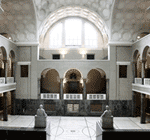 Founded 1472 in Ingolstadt and since 1826 located in Munich, Ludwig-Maximilians-Universität (LMU) München is one of the most prestigious universities in Europe and also one of the largest. The wide range of courses comprises around 150 subjects, ranging from law and economics through the social sciences and the humanities to medicine and the natural sciences. Founded 1472 in Ingolstadt and since 1826 located in Munich, Ludwig-Maximilians-Universität (LMU) München is one of the most prestigious universities in Europe and also one of the largest. The wide range of courses comprises around 150 subjects, ranging from law and economics through the social sciences and the humanities to medicine and the natural sciences.
Together with an atmosphere of liberal-mindedness, this attracts a large number of students each year. Currently, nearly 50,000 students, about fifteen percent of which are international students, take advantage of the highly differentiated spectrum of courses.
The university´s research strength is indicated by thirteen Nobel Prize winners, among them William Conrad Röntgen, Werner Heisenberg and, most recently, Theodor W. Hänsch. This was recently confirmed in a German wide Excellence Initiative Competition and regularly shows in the positions LMU reaches in national and international rankings.
Location: Munich, Germany
Munich is Germany‘s third largest city and offers ideal conditions for studying and conducting research within a vivid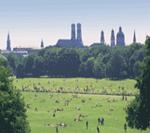 metropolitan yet charming and secure environment. It has a long and impressive history as a hub for research, inventions and higher learning with LMU as the centre and motor of it. metropolitan yet charming and secure environment. It has a long and impressive history as a hub for research, inventions and higher learning with LMU as the centre and motor of it.
Even though Munich is known best for its annual beer fest, the Oktoberfest, its real charm lies in its qualities as a major cultural centre, with world-famous museums and galleries, theatres and concert houses, and the beautiful landscape around it.
A stroll through the “Englischer Garten” is a relaxing break in studying. With the Alps less than an hour away, skiing and mountain biking skills are easily improved. And visiting one of the city’s famous beer gardens is the perfect way to crown a day filled with stimulating lectures.
Academic Highlights and Specific Research Opportunities
LMU Munich is constructed around the four pillars of classical academic research: Humanities, Social Sciences, Natural Sciences and Medicine. 18 faculties offer the possibility of top-level-research in nearly every academic field except Engineering.
The historic part of the campus mainly accommodates the humanities and is located in the city centre, close to the Bavarian State Library and numerous archives. Interdisciplinary centres of research as the Centre for Language and Literature Studies or the Munich Ethics Referral Center offer challenging research opportunities.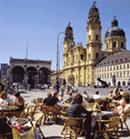
In the field of science and medicine, with a focus on life sciences, the new High-Tech-Campus in Martinsried-Grosshadern, to the south-west of Munich in direct vicinity of the Max Planck Institutes of Biochemistry and Neurobiology, stands for networked research of the highest quality.
The world-class research at LMU is exemplified by its clusters of excellence in the natural sciences – the Munich Center for Integrated Protein Science (CIPSM), the Munich–Center for Advanced Photonics (MAP) and the Nanosystems Initiative Munich (NIM).
|
About EuroScholars - Program Details - Universities - Request Information - Apply Now
EuroScholars - info@euroscholars.eu - 1-800-980-0033
European Office at Leiden University - Gravensteen, Pieterskerkhof 6 - PO Box 9500, 2300 RA - Leiden, the Netherlands
USA Office - c/o GlobaLinks Learning Abroad - 12050 N. Pecos St, Suite 320 - Westminster, CO 80234 - USA |







