University of Geneva, Switzerland
OverviewThe University of Geneva – 450 years of intellectual endeavor
The university is composed of eight faculties: of science, medicine, arts, economic and social sciences, psychology and education, law, theology, and translation and interpretation. It also includes seven interdisciplinary centres and six associated institutes. It is the second largest university in Switzerland with about 16,500 students, of whom more than 38% are international students, enrolled in the various programs from the bachelor to the doctorate. A staff composed of some 4,569 persons (professors, lecturers and assistants) is dedicated to the transmission and advancement of scientific knowledge through teaching as well as fundamental and applied research. Moreover the University of Geneva has been able to preserve the ancient European tradition of an academic community located in the heart of the city. Our Quest for Excellence
The University of Geneva enjoys worldwide recognition for fundamental and applied research. Many international rating bodies have ranked Geneva as a leader in scientific research, in particular in the fields of molecular biology, astrophysics, social sciences and economics. This is why it has been a member of the League of European Research Universities since 2002. As an example, the University of Geneva heads six National Centres of Competence in Research: Frontiers in Genetics, MaNEP - Materials with Novel Electronic Properties, Chemical Biology, Affective Sciences, Synaptic Bases of Mental Diseases and LIVES-Overcoming Vulnerabilities in a Life Course Perspective. Recently, its scientists discovered the first extrasolar planets and realized the first quantum teletransportation. Geneva - Practical Information
|
|||
About EuroScholars - Program Details - Universities - Request Information - Apply Now EuroScholars - info@euroscholars.eu - 1-800-980-0033 |

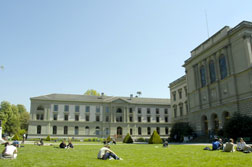 Founded in 1559 by John Calvin, the Academy of Geneva became the University of Geneva in 1873 with the creation of a medical school. The pursuit of higher learning has drawn students and scholars from all over the world to Geneva since the Academy's very creation. Victims of religious persecution, political refugees, students and researchers alike have all drawn intellectual nourishment from the University and made their own contributions to shared intellectual endeavour.